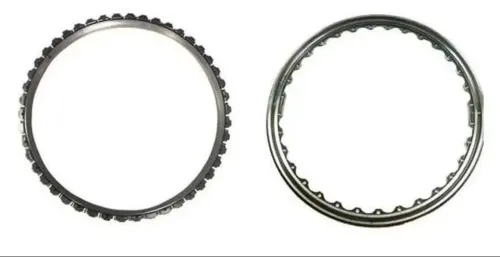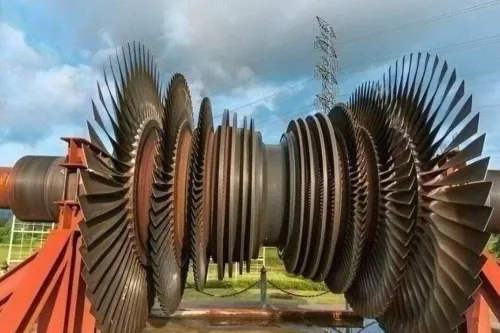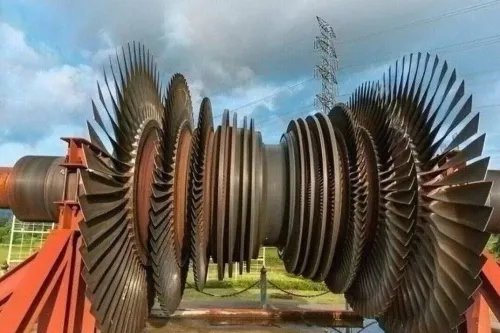

A titanium compressor blade is not a safe replacement because its alloy name, engine family, or overall length matches the removed part. You will be able to identify the correct stage and blade geometry, evaluate TA8DV material claims, check inspection and traceability records, and distinguish an approved replacement from a repair or an unsuitable replica.
Key takeaways
- Use titanium mainly in fan, booster, and cooler compressor stages.
- Match the blade to the exact engine, stage, drawing, and root configuration.
- Require material traceability, inspection results, and release documentation.
- Replace blades when damage exceeds approved repair limits or balance cannot be restored.
Where Titanium Blades Belong in a Compressor
Titanium belongs mainly in the fan, booster, and cooler low- or intermediate-pressure compressor stages, where low density reduces centrifugal load and specific strength supports high-cycle operation. The hottest high-pressure compressor stages usually use nickel-based superalloys or other high-temperature materials because titanium loses useful strength and oxidation resistance as temperature rises.
| Stage | Typical material choice | Selection consequence |
|---|---|---|
| Fan and booster | Titanium is common | Check airfoil, root, platform, and impact limits |
| Intermediate-pressure compressor | Titanium may be used in cooler stages | Confirm local temperature, stress, and approved material data |
| High-pressure compressor | Nickel-based or other high-temperature alloys are common | Do not assume titanium is feasible from the engine name alone |
TA8DV is a material designation, not a complete replacement specification. It does not by itself prove equivalence to Ti-6Al-4V, commercially pure titanium, or another alloy; the governing OEM drawing or material standard must define its chemistry, heat-treatment condition, mechanical properties, and approved substitutions.
That evidence decides whether titanium ta8dv compressor blades belong in the proposed stage, not the supplier’s catalogue label.
A request for “titanium compressor blades in Munich” identifies a location, not suitability. Before comparing suppliers, provide the engine model, module, stage number, and local temperature range; a titanium blade intended for a cooler booster stage can be unsafe in a hotter high-pressure location.
Identify the Blade Before You Compare Suppliers
A proposed blade matches the intended installation only when its identity links the engine model, module, stage and blade position to approved technical data. A search for replacement compressor blades in munich identifies a market, not an engine application.
Request these records before comparing price or lead time:
- Engine model and variant, compressor module, stage number and blade position, such as rotor row, stator row, inner or outer location, and left- or right-hand orientation where applicable.
- Blade part number, serial or batch number, and the governing OEM drawing number with revision; record any superseded or interchangeable part numbers separately.
- Applicability data showing that the proposed part is approved for that exact engine and stage, not merely for the same engine family.
- Release documentation, such as an EASA Form 1 or FAA 8130-3, checked against its approval basis, part number, description, and installation eligibility.
| Record | Strong evidence | Weak clue |
|---|---|---|
| Engine identification | Model, variant, module and stage match the approved data | “Fits the [engine family]” |
| Blade identity | Part number, drawing revision and position designation agree | Similar length or alloy name |
| Approval and traceability | Applicable release document plus serial or batch history | Supplier location, including Munich |
If the seller cannot state the stage and position, stop the comparison. A material certificate alone proves material identity; it does not prove that the blade’s approved design belongs in that rotor row.
Check Airfoil Geometry, Root Fit, and Rotor Balance
Confirm fit against the blade drawing and revision, not the engine-family name or nominal length. Compare a CMM or optical scan with the specified airfoil section coordinates, chord, span, twist, stagger, platform shape, tip configuration and clearance features. A blade with the correct length can still alter efficiency, flutter margin or rotor-to-case clearance.
Check the root as a load-bearing interface, not a cosmetic detail:
- Match the dovetail, fir-tree or other root profile, flank contact, corner radii and seating dimensions to the approved drawing.
- Inspect root surface finish, hardness or case condition where specified, plus nicks, fretting, cracks and unauthorized blending.
- Verify platform location and contact; an incorrect platform can create leakage or rub even when the root seats.
- Confirm leading- and trailing-edge condition with the required inspection method, because dents, pits and machining marks can initiate high-cycle fatigue cracks.
Then verify rotor compatibility. Record each blade’s mass, centre of gravity and moment about the rotor axis, and follow the engine’s blade-matching, weighing or moment-class procedure. Replacing one blade without re-establishing the specified rotor balance can produce unacceptable vibration.
Treat a request for high pressure compressor blades with extra scrutiny: stage temperature, airfoil stress and clearance requirements can make a nominally matching titanium part unsuitable. Dimensional acceptance alone does not prove functional fit; require the installation procedure, balance data and inspection results for the exact stage and blade position.
Require Evidence for Material, Inspection, and Release
Accept a titanium compressor blade only when its records connect the delivered part to an approved design, traceable material, completed inspections, and an authorised release.
Request a traceability package linking the blade serial or lot to the material heat, forging or bar source, heat-treatment cycle, machining-program revision, surface treatment, inspection reports, and final certificate. A generic EN 10204 3.1 certificate does not prove conformity with the blade drawing or completion of special processes.
| Record | Verify | Why it matters |
|---|---|---|
| Approved design data | Part number, drawing revision, engine, module, stage, and applicability | A reproduced sample is not proof of an approved replacement |
| Material evidence | Governing alloy standard, full chemical analysis, heat-treatment condition, tensile or other specified properties, and equivalency approval | “TA8DV” alone cannot establish composition or suitability |
| Inspection results | Dimensional report, airfoil and root measurements, surface-finish results, and accepted NDI such as fluorescent penetrant or ultrasonic testing | Finds cracks, inclusions, and geometry outside drawing limits |
| Process records | Forging, machining, heat treatment, shot peening or coating records, with qualified-process references | Missing special-process evidence leaves a critical manufacturing gap |
| Release documentation | EASA Form 1, FAA 8130-3, or other authorised release document, plus approval basis and installation applicability | A release tag alone does not prove eligibility for your engine or stage |
Ask after market aero engine parts manufacturers to identify every acceptance criterion, not merely mark “passed.” BVPL Turbine Parts should face the same request: traceable records, objective results, and release paperwork matched to the intended installation.
Related services
High Pressure Compressor Blades Material: Titanium – TA8DV With decades of experience and a legacy of excellence, we take pride in our role as a trusted partner for governments, defense organizations, and... View service → |
Aero Engine Blade High Pressure Compressor Blades Material: Titanium – TA8DV High Pressure Compressor Blades Material: Titanium – TA8DV |
Know When a Blade Can Be Repaired—and When It Must Be Replaced
Repair is defensible only when approved repair data gives a measurable damage limit and a qualified process for restoring it. Blend limits, minimum airfoil and edge thickness, root dimensions, and post-repair inspection must be recorded; an acceptable appearance does not prove structural integrity.
| Option | Decision basis | When it applies |
|---|---|---|
| Repair | Damage stays within the approved blend, straightening, or surface-treatment limits; inspection finds no crack | Nicks, erosion, or limited surface damage with remaining material and geometry within tolerance |
| Reject | Damage exceeds limits, or inspection detects cracking, unacceptable deformation, deep work hardening, or an unqualified prior repair | Foreign-object damage that compromises the airfoil, root, platform, or required balance |
| Manufacture replacement | No approved repair exists, or restoration would remove too much material or alter the design | The blade cannot return to drawing dimensions and release requirements |
Foreign-object damage is not only a bent leading edge. Use visual or borescope examination, fluorescent penetrant inspection for surface-breaking indications, dimensional checks, and radiographic or other NDI when the approved data specifies it. A search for titanium compressor blades in Munich does not change those requirements.
Titanium adds process risk: uncontrolled heat can cause oxidation, alpha-case, distortion, or residual stress. Shot peening helps fatigue resistance only when intensity, coverage, media, angle, and masking meet the specification.
A replacement must follow approved design and production data, not a copied sample; A sourcing decision among after market aero engine for parts manufacturers still requires traceability, NDI, and release evidence.
Frequently asked questions
Where do titanium compressor blades belong in an aero engine?
Titanium blades mainly suit fan, booster, and cooler low- or intermediate-pressure compressor stages. The hottest high-pressure compressor stages usually require nickel-based superalloys or other high-temperature materials.
What must you identify before comparing aftermarket compressor blade suppliers?
Identify the engine model, compressor stage, blade part number, revision, airfoil, root design, rotation, and required quantity. Confirm the material grade, including any specified titanium designation such as TA8DV, against the approved technical data.
How do you check whether a replacement compressor blade will fit and balance?
Compare the airfoil profile, chord, twist, thickness, platform, root dimensions, locking features, and datum references with the approved drawing. Check dimensional inspection results and the supplier's rotor-balance or blade-weight control records.
What evidence should an aftermarket compressor blade supplier provide?
Request material traceability to the heat or batch, the applicable material certificate, dimensional inspection results, non-destructive testing records, surface-treatment details, and an authorized release document. Match every record to the blade part number and serial or batch identifier.
When can a titanium compressor blade be repaired instead of replaced?
Repair it only when the engine or component maintenance manual defines an approved process and the damage remains inside its limits. Replace it when cracks, excessive material loss, deformation, corrosion, or an unrecoverable balance condition falls outside those limits.
Related services
Aero Engine Blades and Vanes Blades Material: Inconel and Titanium Blades Material: Inconel and Titanium |
Reverse Engineered Aero Engine Blades and Blisks Reverse Engineered Blades by BVPL Material : Aluminium, Stainless Steel and Titanium Reverse Engineered Blades by BVPL Material : Aluminium, Stainless Steel and Titanium |