
Choose titanium when low density benefits a compressor rotor and the blade’s actual metal temperature, oxidation exposure and fire risk remain within the alloy’s limits. Choose a nickel-based alloy such as Inconel or Nimonic when creep strength, oxidation resistance and hot-gas durability govern the turbine airfoil. By the end, you will have a material, manufacturing and supplier-evidence checklist rather than an interchangeable “Inconel or titanium” label.
Key takeaways
- Start with local metal temperature, including cooling, coatings and transient peaks.
- Compare the exact alloy grade, product form, density and material certificates.
- Check creep, fatigue, centrifugal load and hot-gas damage before choosing.
- Require traceability, heat treatment records and inspection evidence in the purchase order.
Start with the airfoil’s metal temperature, not its engine-section name
Use the airfoil’s local metal temperature as the first screening value, including cooling effectiveness, coating protection and transient peaks.
Titanium belongs on the evaluation list for compressor blades and vanes, where temperatures preserve its strength-to-weight advantage; consider it in a rear-turbine or special application only after the design proves the metal temperature stays within the selected grade’s limit. Do not choose it because the part is called a turbine blade.
| Candidate | Temperature and capability | When to evaluate it |
|---|---|---|
| Titanium alloy | Low density and strong specific strength, but strength and oxidation resistance fall sharply as temperature rises | Compressor airfoils and a demonstrably cool downstream or special turbine location |
| Inconel 718 | Precipitation-hardened wrought alloy with commonly cited service use around 650 °C; not a universal hot-section choice | Moderate-temperature parts where its strength, fabrication route and repair options fit |
| Cast nickel superalloy | Higher creep capability through controlled chemistry, heat treatment and grain structure; density is higher | Hot turbine blades and vanes where sustained metal temperature, oxidation or creep governs life |
Ask gas turbine blade and vane manufacturers to compare the predicted metal-temperature map with the alloy’s allowable values, not merely the compressor or turbine label. First-stage vanes can need cast nickel superalloys, cooling and coatings because gas temperature and oxidation dominate, even without blade centrifugal stress.
For aero engine blade materials, specify the exact titanium or nickel grade before treating any quote as comparable.
Specify the alloy grade, product form and density before comparing quotes
A quote for titanium turbine blades or inconel turbine blades is incomplete until it names the alloy grade, product form and density. “Titanium” could mean Ti-6Al-4V, TA8DV or a near-alpha grade; “Inconel” could mean wrought 718, 625 or cast 939. Their strength, creep resistance, oxidation behaviour, weldability and allowable repairs are not interchangeable.
| Material | Example | Product form | Approximate density |
|---|---|---|---|
| Titanium | Ti-6Al-4V | Forging or machined billet | 4.43 g/cm³ |
| Nickel alloy | Alloy 718 | Wrought bar, forging or ring | 8.19 g/cm³ |
| Nickel alloy | Cast 939 or another airfoil superalloy | Investment-cast airfoil | Grade-specific; obtain the certified value |
At identical geometry and rotational speed, centrifugal force rises with density. A titanium blade can therefore reduce rotor and attachment loads, while a nickel alloy accepts greater hot-section temperature and creep demand.
- Put the governing AMS, EN or OEM specification on the purchase order, followed by the product form and heat-treatment condition.
- State chemistry limits, tensile and creep test temperatures, required grain structure, coating system and inspection method. A cast directionally solidified or single-crystal airfoil is not equivalent to wrought Alloy 718.
- Ask for the certified density and material pedigree before comparing prices. Require heat-lot traceability, mechanical-test reports and repair limitations; otherwise two quotes can describe different service lives under the same alloy name.
Match the material to centrifugal load, creep, fatigue and hot-gas damage
A rotating blade must survive centrifugal stress as well as gas temperature; a stationary vane trades that load for greater exposure to hot-gas attack and thermal gradients. That difference often places titanium in compressor applications and nickel alloys such as Inconel in turbine hot sections.
| Failure mode | Rotating blade | Stationary vane |
|---|---|---|
| Centrifugal load | Radial stress rises with density and speed; Ti-6Al-4V at about 4.43 g/cm³ imposes roughly half the density-driven load of Alloy 718 at about 8.19 g/cm³ for the same geometry. | No comparable rotor load, so density is less decisive. |
| Creep and rupture | Blade metal temperature, stress at the root and dwell time control permanent stretch, tip growth and rupture. | High temperature still drives creep, distortion and loss of throat area, especially near the leading edge and platform. |
| Fatigue | Centrifugal stress combines with vibration and start-stop cycles; attachment fretting can initiate cracks. | Vibratory, thermal-cycle and pressure loads drive cracking, despite the lower mean mechanical stress. |
| Hot-gas damage | Oxidation, erosion and deposits attack the airfoil; titanium also risks ignition after rubbing or impact. | Oxidation, corrosion, erosion and steep thermal gradients can destroy the leading edge and coating. |
The implication for aero engine blade materials is direct: do not select titanium for a first-stage turbine blade because its low density reduces rotor load. Its temperature and oxidation limits usually rule it out there.
Gas turbine vane materials face no rotor centrifugal penalty, but a first-stage vane can still require cast nickel superalloy, internal cooling and a coating; Inconel 718 and 939 are not interchangeable on creep or oxidation performance.
Check whether the manufacturing route can deliver the required airfoil
An airfoil can meet an alloy callout and still fail because the supplier cannot produce its cooling passages, grain structure, or repairable surface. For gas turbine blade and vane manufacturers comparing Inconel or titanium, approve the manufacturing route, not the material name alone.
- Ask whether the titanium part is forged, then CNC-finished. Forging supports sound compressor airfoils, while machining must control heat, chatter, galling, tool wear, and minimum stock for blending.
- Ask whether the nickel part is investment-cast. Equiaxed, directionally solidified, and single-crystal structures provide different resistance to creep, fatigue, and thermal cracking; they are not interchangeable.
- Require the specified grain structure, heat-treatment condition, chemistry limits, and inspection method on the drawing or purchase order. A cast nickel vane with internal cooling needs different evidence from a wrought titanium compressor blade.
- Review CNC controls for both alloys. Nickel work-hardens and develops a hardened rubbed layer; titanium retains cutting heat and reacts with tools. Confirm tool material, coolant delivery, engagement strategy, and blend limits.
- Define repair before approval. Ask which weld, braze, blend, coating-strip, and dimensional restoration processes are allowed, and how repaired zones are inspected. A part that cannot be restored after an edge nick can cost more than its purchase price.
BVPL Turbine Parts is worth comparing on this evidence: request the route, grain record, heat treatment, CNC inspection, and approved repair procedure behind any titanium turbine blades or nickel airfoil.
Related services
Aero Engine Blades and Vanes Blades Material: Inconel and Titanium Blades Material: Inconel and Titanium |
High Pressure Compressor Blades Material: Titanium – TA8DV With decades of experience and a legacy of excellence, we take pride in our role as a trusted partner for governments, defense organizations, and... View service → |
Use a procurement checklist that proves the material will survive service
Approve the part only when the manufacturer links its material, process and inspection evidence to the local metal temperature, loads, environment and required life—not to an engine-section label.
1. Require the exact alloy grade, product form and heat-treatment condition. “Inconel turbine blades” could mean wrought IN718, IN625 or cast IN939; “titanium turbine blades” could mean Ti-6Al-4V, TA8DV or a near-alpha grade.
2. Require the governing AMS, ASTM or customer specification, including chemistry limits, density, grain structure and mechanical-property results at the design test temperature. Room-temperature tensile strength does not prove creep life.
3. Require a temperature map showing compressor discharge temperature or turbine local metal temperature, including start-up, shutdown and over-temperature transients. Compare that evidence with creep-rupture, fatigue, oxidation and thermal-gradient limits.
4. Require the manufacturing record: forging or investment-casting route, equiaxed, directionally solidified or single-crystal structure, heat treatment, CNC finishing and batch traceability. For gas turbine vane materials, confirm that the leading edge, platform and cooling passages match the stated design.
5. Require the complete coating and cooling specification, including bond coat, ceramic topcoat, thickness limits and inspection method. For titanium compressor parts, demand documented rub, foreign-object-damage, fire and containment assessments.
6. Require dimensional inspection, radiography or computed tomography where specified, fluorescent penetrant or eddy-current results, and acceptance criteria for cracks, porosity and wall thickness.
7. Require the approved repair process, weld or braze limits, repair inspection and remaining-life basis. Reject a supplier that offers a repair without defining its effect on heat treatment, coating and fatigue life.
Frequently asked questions
Should you choose Inconel or titanium based on the engine section?
No. Screen the airfoil using local metal temperature first, then account for cooling effectiveness, coating protection and transient temperature peaks.
What must you compare before requesting quotes for turbine blades or vanes?
Specify the alloy grade, product form, density, heat treatment condition, tolerances and material certification requirements.
When are Inconel turbine blades preferable to titanium turbine blades?
Choose Inconel when the airfoil faces higher metal temperatures, creep exposure or hot-gas damage that titanium cannot tolerate.
What manufacturing questions should you ask gas turbine blade and vane manufacturers?
Ask whether the proposed route can produce the required airfoil geometry, cooling passages, surface finish, dimensional tolerances and inspection results.
What evidence should a procurement checklist require?
Require heat and batch traceability, mill certificates, heat-treatment records, coating details, non-destructive testing and dimensional inspection reports.
Related items
Aero Engine Blade High Pressure Turbine and Intermediate Pressure Turbine Blades Material: Nimonic 115 High Pressure & Intermediate Pressure Turbine Blades Material: Nimonic 115 Nimonic 115 is a high-performance nickel-chromium-cobalt alloy engineered... |
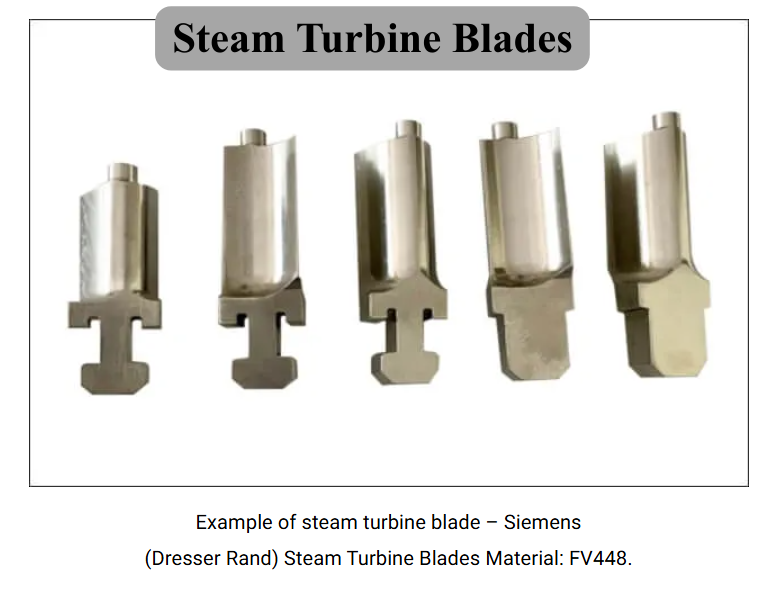 | Steam turbine components manufacturer Steam Turbine Blades and Vanes BVPL Turbine Parts manufactures precision steam turbine blades and vanes used in power generation turbines and industrial steam systems. View product → |