
A blade that looks correct can still fail because its stage position, root attachment, material, coating, or airfoil geometry is wrong. Use the engine data first, then compare design fit, manufacturing route, approvals, inspection evidence, and qualified cost before selecting a Munich supplier.
Key takeaways
- Confirm engine model, stage, serial number, and released part data first.
- Match compressor or turbine blades to temperature, pressure, speed, and duty.
- Check airfoil, root, coating, inspection records, and manufacturing route.
- Compare suppliers by qualified cost, traceability, capacity, and programme risk.
Start with the engine, stage, and released part data
Identify the exact released configuration before requesting a price. Aero engine parts manufacturers blade selection starts with the engine model, variant, serial number, stage position, and assembly location.
1. Record the released part number and drawing revision. Add the OEM or type-design reference, blade quantity, left- or right-hand geometry, and whether the blade is a rotor blade, stator vane, guide vane, or compressor or turbine blade.
2. Define the geometry the supplier must reproduce. Provide the airfoil section, leading- and trailing-edge dimensions, camber, stagger, twist, platform, shroud, tip-clearance limits, and root attachment type, such as fir-tree or dovetail. Ask for the drawing datum scheme and the engine-maker’s profile-evaluation method; a generic dimensional-tolerance figure cannot prove aerodynamic compatibility.
3. State the material, condition, and process route. Identify the alloy, heat-treatment specification, surface finish, shot-peen condition, coatings, masking limits, and every special process named on the release. MCrAlY, aluminide, or ceramic thermal-barrier coatings change dimensions and inspection requirements.
4. Name the acceptance authority and required records. Specify first-article inspection, non-destructive testing, material certificates, traceability, and any destructive coupons. EN 9100 shows a quality-management system; it does not approve a supplier for your engine part.
When comparing aero engine blade options in Munich, send this complete data pack to each bidder. Otherwise, quotations may describe different parts, processes, and qualification burdens.
Match the blade type to its operating duty
A blade’s position determines its failure risks. Rotating airfoils carry centrifugal stress and vibratory fatigue; stationary vanes carry aerodynamic pressure, thermal gradients, and attachment loads without centrifugal loading. Guide vane and stator vane can overlap in terminology, so confirm the drawing’s station and function.
| Type | Location and duty | Loading and material requirement |
|---|---|---|
| Compressor blade | Rotating compressor rotor; raises air pressure | High-speed centrifugal and fatigue loading, thin-edge foreign-object damage; titanium alloys are common, with nickel alloys in hotter rear stages |
| Turbine blade | Rotating turbine rotor; extracts gas energy | Extreme centrifugal, thermal, creep, oxidation, and vibratory loading; nickel-base superalloys, cooling passages, and protective coatings are central |
| Guide vane | Fixed inlet or nozzle row directing flow into a rotor | Pressure, thermal gradients, and impact loading; material ranges from titanium or steel in cool sections to nickel alloys in hot turbine nozzles |
| Stator vane | Fixed row between rotor stages, straightening or turning flow | Aerodynamic pressure, platform distress, and thermal fatigue; match the stage temperature, coating, and any cooling requirement |
| Rotor blade | Any rotating compressor or turbine airfoil attached to a disk | Centrifugal stress, root fretting, balance, and vibration; material follows its compressor or turbine duty, not the name alone |
Compare compressor and turbine stage blades by temperature, speed, pressure ratio, oxidation exposure, and damage mechanism—not by profile alone. A quotation for aero engine blade options in munich must name the exact alloy, product form, heat treatment, coating, and cooling configuration; “aerospace titanium” or “aerospace nickel” is not a usable material definition.
Verify airfoil, root, coating, and manufacturing route
A blade that looks right can still fail in service if its root, material, or internal features do not match the released design. Confirm compatibility against the drawing revision, engine-maker data, and inspection method—not a photograph or a supplier’s generic sample.
- Airfoil: compare leading-edge radius, trailing-edge thickness, camber, stagger, twist, platform alignment, and section coordinates against the specified datums. Ask how the manufacturer evaluates profile error, because a single dimensional tolerance will not show incidence, leakage, vibration, or clearance risk.
- Root: verify the fir-tree or dovetail flank form, contact geometry, edge breaks, surface finish, residual-stress condition, and shot-peen coverage. A correct airfoil cannot compensate for an attachment that carries load incorrectly.
- Material: name the exact alloy specification, product form, heat treatment, and material pedigree. Titanium compressor alloys and nickel-base turbine alloys are not commercial substitutes; density, temperature capability, oxidation behaviour, fatigue, and machining response differ.
- Coating: identify the coating system, bond coat, thickness range, masking limits, adhesion test, surface preparation, and approved applicator. Check that the coating suits the blade’s temperature and oxidation or hot-corrosion duty.
- Manufacturing route: document forging or casting, machining sequence, heat treatment, special processes, and inspection gates. For cooled turbine blades, require radiography or computed tomography plus flow or borescope checks for blocked, undersized, or misplaced passages; use fluorescent penetrant inspection for relevant surface cracks.
For compressor and turbine stage blades, require first-article evidence tied to the same route, tooling, and revision proposed for production. A precision aero engine blade manufacturer should show traceable dimensional results, material certificates, coating records, and non-destructive testing—not merely a visually similar part.
Qualify the Munich supplier beyond its machine list
A Part-145 approval does not authorise manufacture of new type-designed blades. For civil work, choose aero engine blades gas turbine blade and vane manufacturers in Munich by matching the supplier’s approval to your purchase: EASA Part 21 Subpart G production approval addresses new parts, while Part 145 covers maintenance and repair.
1. Ask for the approval certificate, scope, and approved production sites. Check that the scope covers the part category, engine programme, and processes you will buy. EN 9100 demonstrates an aerospace quality-management system; it does not approve a particular blade or special process.
2. Request representative evidence from the same process family: a comparable airfoil size and alloy, root attachment, internal passage, coating, and inspection method. Look for validated fixtures, balancing, metrology, and hot-section controls—not only a list of five-axis machines.
3. Require an AS9102 first-article package tied to the released drawing or model. It should include ballooned characteristics, dimensional results, material and heat-treatment certificates, special-process records, and agreed nonconformance history. AS9102 proves process capability against design data; it does not replace your configuration-control approval.
4. Treat coating as design data. Confirm the MCrAlY, aluminide, or ceramic system, bond-coat preparation, masking, thickness limits, adhesion controls, and post-coat dimensional acceptance.
A precision aero engine blade manufacturer should also explain CT or radiographic inspection, destructive coupons, scrap controls, and subcontractor oversight. BVPL Turbine Parts belongs in your comparison only after it supplies this evidence for the specified blade family, rather than relying on general CNC capability.
Related items
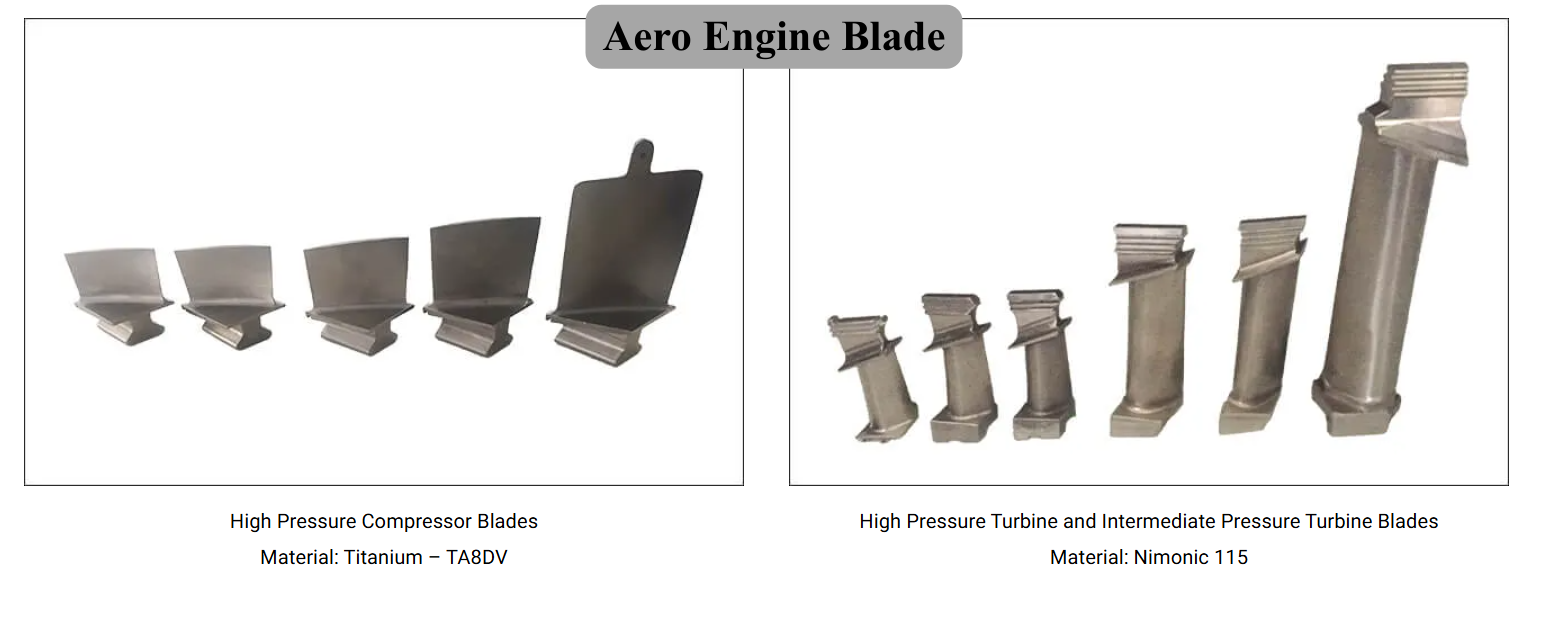 | Precision Components Manufacturer Aero Engine Blade View product → |
Reverse Engineered Aero Engine Blades and Blisks Blisks for Aero Engines Material : Stainless Steel Blisks for Aero Engines Material : Stainless Steel |
Compare quotations by qualified cost and programme risk
The lowest unit price can hide the highest programme cost. Treat aero engine parts manufacturers blade selection as a qualified-cost exercise: compare the price of an accepted, documented blade, not an unfinished machined component.
| Quoted line | What it adds to real cost or risk |
|---|---|
| Tooling and fixtures | Non-recurring design, manufacture, proving, and storage charges |
| First article and inspection | AS9102 records, dimensional reports, CT or radiography, and test coupons |
| Special processes | Heat treatment, shot peening, coating, NDT, and subcontractor management |
| Certification package | Material, process, traceability, conformity, and export-control documentation |
| Requalification | Recurring approval after a process, source, material, or drawing change |
Ask each bidder to separate non-recurring engineering from the recurring unit price, state assumptions, and price scrap, minimum order quantities, lead time, and inspection repeats. A cheap quote becomes expensive when coating capacity or a failed first article adds weeks.
To choose aero engine blades gas turbine blade and vane manufacturers in Munich, require evidence that the quoted route matches the released design data:
- Confirm the drawing revision, material and heat-treatment specification, special processes, acceptance authority, and configuration-control method.
- Request ballooned drawing or model-based-definition results, material certificates, process certificates, and agreed nonconformance history.
- Check whether the supplier holds EASA Part 21 Subpart G production approval for new parts; Part 145 maintenance approval covers repair activity, not automatically new manufacture.
- Treat EN 9100 as quality-system evidence, not part approval, and make recurring requalification costs explicit in the purchase order.
Frequently asked questions
What released data should you provide when selecting aero engine blades?
Provide the engine model and variant, engine serial number, stage position, assembly location, part number, revision, and released drawings or specifications.
How do compressor and turbine stage blades differ in operating duty?
Compressor blades handle progressive pressure rise and rotating aerodynamic loads, while turbine blades face higher gas temperatures, thermal gradients, oxidation, and creep risk.
Which blade features must you verify before placing an order?
Verify the airfoil geometry, root interface, material, coating system, balance requirements, inspection plan, traceability, and approved manufacturing route.
How should you compare Munich aero engine parts manufacturers?
Compare their experience with the specific blade family, process controls, inspection capability, documentation, capacity evidence, lead time, and the cost of qualification and programme risk.
Related services
Reverse Engineered Aero Engine Blades and Blisks Reverse Engineered Blades by BVPL Material : Aluminium, Stainless Steel and Titanium Reverse Engineered Blades by BVPL Material : Aluminium, Stainless Steel and Titanium |
Aero Engine Blades and Vanes Blades Material: Inconel and Titanium Blades Material: Inconel and Titanium |