
A Munich address does not prove that a company forges, machines, inspects, or ships compressor blades from Munich. By the end, you will be able to verify a supplier’s actual production location, identify the correct titanium compressor stage, define TA8DV documentation, and compare quotations on fit, process control, and aerospace quality evidence.
Key takeaways
- Verify the factory address, machining location, and export route before treating a supplier as local.
- Place titanium compressor blades by stage, airflow direction, and engine drawing—not by marketing name.
- Define TA8DV with the governing material standard, heat treatment, and acceptance tests.
- Request approval records, inspection plans, traceability documents, and sample reports with your RFQ.
How to verify whether a blade manufacturer is actually near Munich
A Munich postcode does not prove that a supplier manufactures blades there. A search for gas turbine blade and vane manufacturers near Munich can return a sales office, broker, or German coordinator whose parts come from another country.
| Supplier claim | Evidence to request | Classification |
|---|---|---|
| Munich manufacturing site | Production address, site contact, machine list, and a live or in-person facility visit | Munich-area manufacturer |
| Bavaria-based production | Legal entity, exact factory address, and shipping records showing that site as the ship-from location | Bavarian manufacturer, not necessarily Munich city |
| Munich sales or coordination office | Manufacturing address, subcontractor identity, and contract party responsible for conformity | Regional seller or coordinator |
Ask the supplier to name the site that will forge, machine, heat-treat, inspect, and release your titanium compressor blades. Confirm that the quotation, quality agreement, certificates, and delivery note identify the same legal entity and production location. A local office that cannot disclose the manufacturing site does not qualify as a Munich-area manufacturer.
Treat AS9100 as evidence of an aerospace quality-management system, not proof of blade capability. Check the certificate’s site address, then request drawing-specific approvals, first-article records, titanium root and airfoil examples, inspection-equipment details, and melt-to-part traceability.
Nadcap also needs a scope check. Confirm that the named site holds accreditation for the actual heat treatment, chemical processing, non-destructive testing, or measurement operation rather than accepting “Nadcap approved” as a blanket claim.
Where titanium compressor blades sit in the engine
A titanium high-pressure compressor blade is not a complete technical description. “High pressure” identifies a compressor module, not a universal location or temperature; the engine model and stage number determine whether titanium is suitable.
1. Fan and low-pressure compressor stages sit at the front of the core flow path. Titanium is common here because temperatures remain relatively low and its density, about 4.43 g/cm³ for Ti-6Al-4V, reduces rotating mass.
2. Intermediate-pressure compressor stages operate farther downstream. Titanium can remain suitable, but the allowable temperature depends on the engine’s pressure ratio, cooling arrangement, and material limits.
3. High-pressure compressor stages are not one uniform zone. Forward HPC stages may use titanium, while rear stages facing higher compressor-exit temperatures may require nickel alloys or steels. Titanium is not interchangeable with those alloys simply because the airfoil looks similar.
4. A blade rotates with the disk; a vane is stationary and guides airflow between rotor rows. “Titanium high pressure compressor blades” therefore describes a different component from titanium stator vanes, even at the same stage.
For an RFQ, state the engine model, module, stage, rotation direction, and whether you need a blade, vane, or repair part. Tie the alloy callout to the required AMS, ASTM, EN, or engine-maker specification and product form.
A forged, heat-treated blade with controlled grain flow is not equivalent to a complete airfoil milled from generic bar.
What TA8DV must mean on a purchase order
The phrase ta8dv compressor blades does not identify a complete aerospace material requirement. Treat TA8DV as an unresolved trade, translation, or catalogue designation until the supplier names the governing AMS, ASTM, EN, or engine-maker specification.
| Purchase-order field | What to require | What failure it prevents |
|---|---|---|
| Material identity | Full chemical designation, governing specification and revision, plus chemistry limits | A substituted or unexplained titanium grade |
| Product form | Qualified forging, forged blade, billet, or bar; state the permitted route and grain-flow requirement | Milling the complete blade from generic bar |
| Condition | Exact solution-treatment, ageing, stress-relief, cooling, and hardness or mechanical-property requirements | Accepting material in the wrong heat-treatment condition |
| Equivalence | Written approval for any alternate standard, grade, or translation; never assume Ti-6Al-4V equivalence | Comparing unlike material pedigrees |
For titanium high-pressure compressor blades, tie the callout to the finished blade or its qualified forging route, not only to raw stock. State tensile and yield requirements, elongation, test temperature, and acceptance criteria where the governing specification requires them.
Require these records with each lot:
- Mill certificate identifying chemistry, heat number, product form, and specification revision
- Forging record showing billet or bar heat number, die or forming route, and grain-flow compliance
- Heat-treatment chart with furnace identification, cycle temperatures, hold times, atmosphere, and quench or cooling details
- Hardness and mechanical-test results linked to the same heat or batch
- Material and process traceability from melt through forging, machining, inspection, and shipment
Reject a certificate that says only TA8DV or “equivalent.” Get the exact standard before comparing price or lead time.
How to compare blade fit and manufacturing capability
A replacement compressor blade must match the engine’s load-bearing interfaces, not just its visible airfoil. Compare the engine model, module and stage, blade part number or drawing revision, rotation direction, and balance requirement before comparing machining claims.
| Check | Evidence of replacement capability | Red flag |
|---|---|---|
| Root or dovetail | CMM results for flank angles, radii, platform contact, and datum location against the drawing | “Fits the slot” based on a visual sample |
| Airfoil | Scanned sections at specified heights, with chord, thickness, twist, leading-edge radius, and trailing-edge limits reported | One overall profile measurement or photographs |
| Platform and tip | Inspection of platform shape, shroud features, tip clearance, and blend limits | Airfoil-only inspection |
| Machining control | Simultaneous-axis accuracy data, probing routines, tool-wear control, and a datum plan linking forged stock to final inspection | “5-axis CNC” stated without accuracy or datum evidence |
| Material pedigree | Forging or formed-stock route, billet or bar heat number, grain-flow records, and heat-treatment results | Complete milling from generic titanium bar |
Ask for a first-article inspection report that ties every critical dimension to the drawing revision, inspection equipment, and serial number. The inspection plan should include CMM or equivalent airfoil measurement, root-form checks, surface finish, visual examination, and fluorescent penetrant testing when the drawing or approved process requires it.
- Confirm the supplier has produced comparable titanium root and airfoil geometries, not merely similar shapes.
- Treat AS9100 as quality-system evidence, not blade capability.
- Check Nadcap scope for the actual heat-treatment, NDT, chemical-processing, or measurement operation.
- Give aero engine compressor blade suppliers identical models, revisions, tolerances, NDT classes, and traceability requirements; otherwise quotations are not comparable.
What approval and inspection evidence should accompany your RFQ
Do not compare quotations until every supplier prices the same evidence package. Ask aero engine compressor blade suppliers to quote against the drawing or model revision, stage, material and product-form specification, forging and heat-treatment requirements, tolerances, surface finish, blend limits, NDT method and acceptance class, report format, and melt-to-part traceability.
Request these documents with the offer:
- AS9100 certificate showing the legal entity and manufacturing site; treat it as quality-system evidence, not blade approval.
- Nadcap certificate and current scope for the actual operation: heat treatment, chemical processing, non-destructive testing, or measurement.
- Material certificate naming the applicable AMS, ASTM, EN, or engine-maker specification, product form, heat number, chemical analysis, mechanical results, and heat-treatment condition.
- Process qualifications for forging, machining, shot peening, coating, NDT, and repairs, with procedure and acceptance references.
- Inspection records covering root geometry, airfoil coordinates, runout, balance, surface finish, and calibrated CMM or gauge equipment.
- AS9102 first-article inspection report, including Forms 1–3, ballooned drawing, characteristics list, measurement results, and nonconformance disposition.
| Evidence | What it proves | Check before comparing |
|---|---|---|
| Certificate of conformity | The delivered blade matches the order | Part number, revision, quantity, and authorized signature |
| FAI package | The process produced one conforming part | Same drawing revision and material form |
| Nadcap approval | A controlled special process | Scope, site, expiry, and process match |
Gas turbine blade and vane manufacturers near Munich should identify the producing site and subcontractors. BVPL Turbine Parts should be asked for this same drawing-specific package, not a generic capability statement.
Related services
High Pressure Compressor Blades Material: Titanium – TA8DV With decades of experience and a legacy of excellence, we take pride in our role as a trusted partner for governments, defense organizations, and... View service → |
Aero Engine Blade High Pressure Compressor Blades Material: Titanium – TA8DV High Pressure Compressor Blades Material: Titanium – TA8DV |
Frequently asked questions
How can you verify whether a blade manufacturer is actually near Munich?
Check the physical manufacturing address, visit or audit the machining site, and ask where raw material, heat treatment, inspection, and final packing occur. A Munich sales office or coordinator does not prove local production.
Where do titanium compressor blades sit in a gas turbine engine?
They sit in the compressor, ahead of the combustor, where rotating blade rows compress incoming air. Titanium is used in selected compressor stages rather than in the hot turbine section.
What must TA8DV mean on a purchase order?
Define TA8DV by its exact material standard or drawing reference, chemical limits, heat-treatment condition, mechanical properties, surface requirements, and inspection acceptance criteria. Do not use the designation without those references.
What evidence should accompany an RFQ for titanium compressor blades?
Request the applicable drawing revision, supplier approvals, material certificates, heat-treatment records, inspection plan, dimensional report, nonconformance process, and full part traceability.
Related items
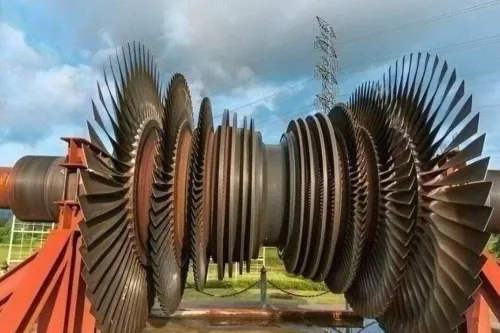
Steam TurSteam turbine components manufacturerbine Blades We are a leading steam turbine components manufacturer dedicated to engineering high quality, performance-driven steam turbine components, including... View service → |
 | Steam turbine components manufacturer Steam Turbine Blades and Vanes BVPL Turbine Parts manufactures precision steam turbine blades and vanes used in power generation turbines and industrial steam systems. View product → |