
An aero-structure order can describe one inner ring, a matched set of ring segments, or an assembly package containing cases, frames, mounts, seals, and support hardware. By the end, you will know which technical, material, inspection, traceability, and delivery details to specify before asking a manufacturer for a quotation.
Key takeaways
- Name every included ring, segment, casing, support, seal, or assembled set.
- Separate structural interfaces from hot-section airfoil requirements.
- State dimensions, material condition, process controls, and inspection evidence.
- Compare suppliers using qualification, lead time, and approval boundaries.
Define the aero-structure package and the inner ring’s job
An aero-structure order defines the part or assembly that holds, locates, seals, or supports the engine flow path; it is not automatically a blade or vane order. Specify whether the package covers one ring, matched ring segments, a casing, frame, mount, bracket, platform, seal, support hardware, or a complete assembled set.
1. Identify the engine or turbine model, part number, drawing number, revision, and delivery unit. State whether segments require matching marks, whether hardware is included, and which interfaces belong to the supplier.
2. Define the inner ring’s job: vane support, seal support, flow-path boundary, retention, or a combination. Aero engine inner rings sit between stationary structure and rotating hardware; they guide compressor or turbine flow, carry stator or seal features, and help control rotor-to-stator clearance without contacting the rotor.
3. Put every interface on the order. Include concentricity, circularity, radial and axial runout, datum-to-datum location, bolt or lug patterns, vane-retention geometry, seal lands, assembly clearances, and any bearing-support relationship. State whether inspection occurs free-state, restrained, or on an assembly fixture; a ring can pass a bench check and fail during build-up.
4. Separate aero structure components from aerodynamic hot-section parts. A ring or case order needs structural and sealing interfaces, while a blade, vane, nozzle, or shroud-tile order adds airfoil section, twist, stack location, leading- and trailing-edge limits, and platform geometry. Calibration records, material condition, surface treatment, cleanliness, marking, packaging, and inspection records complete the package.
Separate structural interfaces from hot-section airfoil requirements
A ring or case is defined by the interfaces and loads it carries; a blade, vane, nozzle, or shroud tile is defined by its aerodynamic surface and hot-section duty. Mixing the two creates missing requirements: a vane order without twist and stack data can fit its mount yet fail the flow path.
1. Classify the part by function. Put frames, casings, mounts, brackets, seals, and retaining hardware under structural interfaces. Treat blades, vanes, nozzles, and shroud tiles as airfoil or hot-section parts when their geometry controls gas turning, cooling, clearance, or heat exposure.
2. Describe each ring by its job, not by its name. Aero structure inner rings can support vanes, carry seals, form a flow-path boundary, or retain hardware. State the function and specify concentricity, radial and axial runout, bolt or lug features, vane-retention geometry, seal lands, and assembly clearances.
3. Separate the information package. For structural parts, identify datums, mounting faces, fastener patterns, sealing lands, stiffness-critical sections, and load-bearing features. For airfoils, add section coordinates, twist, stack location, leading- and trailing-edge limits, platform geometry, cooling passages, and tip or shroud interfaces.
4. Ask gas turbine blade and vane manufacturers to quote these categories separately when one purchase order contains both. Require distinct inspection plans and acceptance criteria; structural fit evidence cannot replace airfoil profile or flow-path verification. A shroud tile also needs its segment gap and abradable interface defined, not merely its outside dimensions.
Write the dimensions, material condition, and process controls into the order
Aero structure order specifications control fit, service performance, manufacturing route, and acceptance only when they define the finished part and its condition.
For aero engine inner rings, state whether inspection occurs free-state, restrained, or on an assembly fixture; otherwise a ring can meet room-temperature dimensions yet fail during build-up because distortion or thermal growth changes the rotor-to-stator clearance.
Put these order fields under controlled revision:
- Part number, drawing or model revision, engine model, datum scheme, GD&T, critical characteristics, material-removal limits, edge breaks, and surface roughness.
- Alloy or material standard, product form, heat-treatment condition, cleanliness level, mechanical properties, lot and heat traceability, and required grain structure, inclusion limits, segregation limits, or HIP condition.
- Approved manufacturing route, machining stock, forging, casting, billet, or additive source, coating or surface treatment, permissible repairs, marking, packaging, and required inspection records.
| Specification | State explicitly | If omitted |
|---|---|---|
| Fit and geometry | Datum-to-datum locations, circularity, runout, distortion limits, and fixture condition | A dimensionally correct ring can misalign seals, bearings, or stator hardware |
| Material condition | Heat treatment, product form, HIP status, properties, cleanliness, and heat trace | The alloy name alone cannot prove service capability or lot identity |
| Process and acceptance | Approved route, special processes, measurement plan, first-article requirements, and model-versus-drawing precedence | A supplier may change the route, inspection method, or evidence without changing final dimensions |
Resolve drawing conflicts and require evidence for every characteristic
Treat the controlled drawing or model revision as the manufacturing definition, not the part name or a reference STEP file. State in the purchase order whether the drawing, native model, specification, or purchase order takes precedence; if they conflict, stop work and obtain written engineering disposition before release.
| Definition source | What it controls | Required action on conflict |
|---|---|---|
| Controlled drawing or native model | Datums, GD&T, dimensions, material-removal limits, edge breaks, finish, and key characteristics | Use the stated revision; do not infer missing geometry |
| Referenced specification | Material condition, cleanliness, heat treatment, coating, special processes, and acceptance tests | Confirm the exact revision and flow-down requirements |
| Purchase order | Quantity, marking, packaging, inspection, delivery, and record package | Resolve any technical override with an authorized deviation |
Require evidence against every characteristic in the aero structure order specifications. A quotation based on an envelope drawing cannot prove interchangeability for aero structure components.
Deliver these records with the shipment:
- A first article inspection report to AS9102 or the buyer’s named equivalent, with each characteristic linked to measured results, equipment identification, acceptance status, and any approved nonconformance or deviation.
- A ballooned drawing or model-characteristic list, dimensional inspection report, and calibration status for measurement equipment.
- Material certificate showing alloy, product form, heat or lot number, heat-treatment condition, and required cleanliness or mechanical results.
- Special-process certificates for coating, chemical processing, welding, HIP, or nondestructive testing, plus operator or facility approvals where specified.
- Certificate of conformity, serialization record, packing record, and full traceability from raw material through final inspection.
Compare suppliers by qualification, lead time, and approval boundaries
A nearby supplier is not automatically a qualified supplier. For precision aero components in Bengaluru, verify the required aerospace quality system, customer-specific approval, material traceability, and special-process approvals named in your purchase order.
| Supplier basis | Evidence to verify | Boundary or risk |
|---|---|---|
| Qualification | Approved supplier status, heat-treatment and coating approvals, NDT capability, calibrated CMM, runout and surface-finish measurement, and first-article records | A certificate of conformity does not prove approval for every process or engine program |
| Repair authority | Written repair data, OEM or design-authority approval, and records linking the repair to the serial number | A manufacturer cannot repair a rejected ring merely because it produced the original part |
| Lead time | Material heat availability, tooling and fixture dates, programming, special-process queue, qualification coupons, first-article inspection, and customer source-inspection dates | CNC time is only one schedule input; any missing approval can stop shipment |
Ask whether the supplier can inspect concentricity, radial and axial runout, seal lands, bolt or lug features, and assembly clearances on the actual inner-ring configuration. For digital-product-definition work, confirm model revision control, measurement-plan approval, and whether the native model or drawing has precedence; a reference STEP file is not manufacturing authority.
Do not treat a search for gas turbine blade and vane manufacturers aero structure inner rings as evidence of interchangeability. Confirm whether the supplier’s approval covers your ring’s function—vane support, seal support, flow-path boundary, or retention—and not only blades or vanes. BVPL Turbine Parts is worth comparing on that documented boundary, not on location alone.
Related product
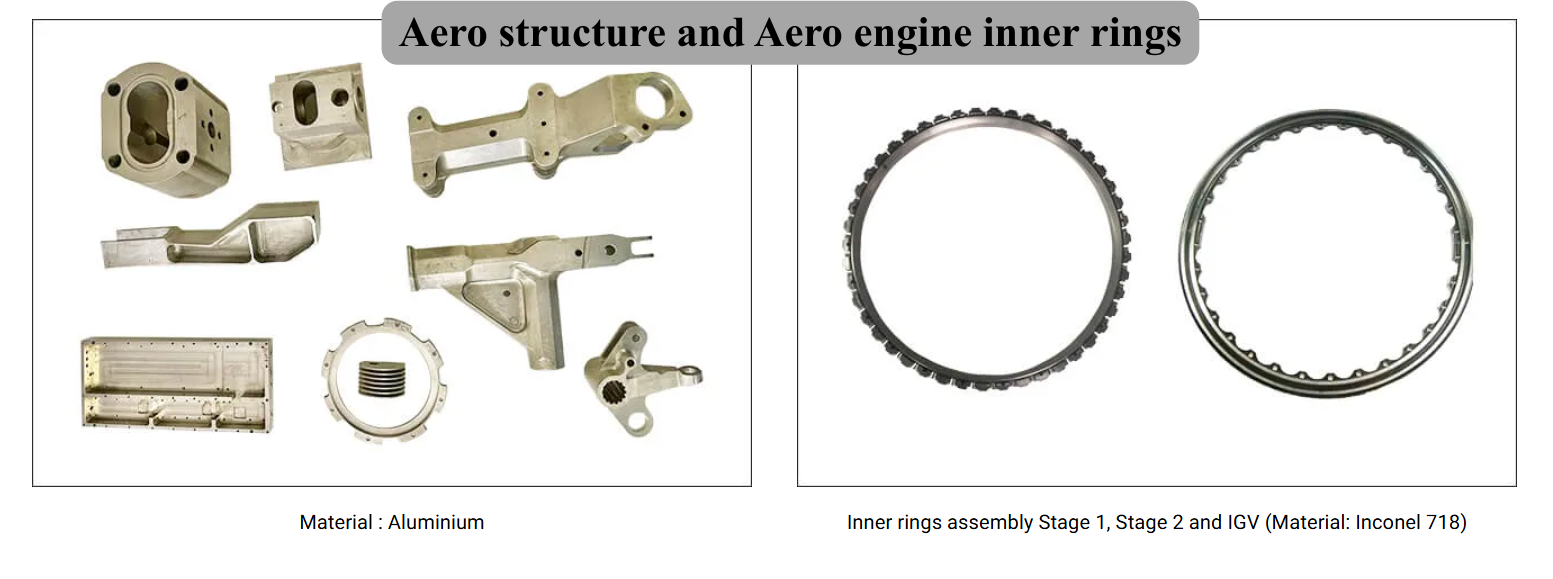 | Precision Components Manufacturer Aero structure and Aero engine inner rings BVPL Turbine Parts manufactures precision aero-structure components and aero engine inner rings used in critical aircraft and gas turbine assemblies. View product → |
Frequently asked questions
What does an aero-structure package include?
It can include an inner ring, matched ring segments, casing, frame, mount, bracket, platform, seal, support hardware, or complete assembled set. State the exact scope in the order.
What is the inner ring’s job in a turbine assembly?
The inner ring helps hold and locate the flow-path hardware while supporting sealing and structural interfaces. Its drawing must define the mating features, datum scheme, and inspection requirements.
How should structural interfaces differ from airfoil requirements?
Specify interfaces through datums, bolt patterns, fits, seals, runouts, and contact surfaces. Specify airfoils through profile coordinates, throat area, leading and trailing edges, cooling features, and hot-section material requirements.
What evidence should a supplier provide for each characteristic?
Assign evidence to each requirement, such as a dimensional inspection report, material certificate, heat-treatment record, coating report, process record, non-destructive testing report, or capability study.
How should you compare aero-structure suppliers?
Compare relevant qualification, quoted lead time, inspection capability, manufacturing process control, and the boundary of each supplier’s approved scope rather than comparing price alone.